Artificial intelligence is changing how businesses handle customer service, sales, IT support, and everyday operations. In 2026, terms such as AI agent, chatbot, AI assistant, agentic AI, and autonomous AI are becoming common across business software.
But these technologies are not necessarily the same.
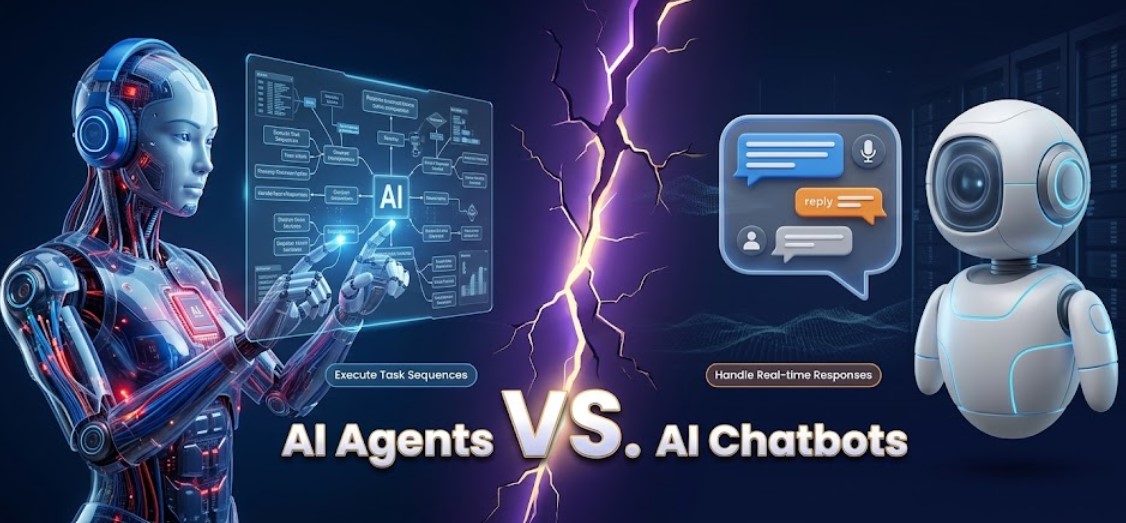
The simplest difference is autonomy. A chatbot primarily understands questions and provides responses. An AI agent can understand a goal, reason about the required steps, use tools, take actions, and work toward completing the task.
For businesses evaluating AI software, understanding the difference between an AI agent vs chatbot can prevent costly buying decisions and help teams choose the right level of automation.
What Is an AI Agent?
An AI agent is an AI-powered system designed to achieve a goal with a degree of autonomy. It can interpret a request, determine what needs to happen, access relevant information, use tools or APIs, perform actions, and evaluate the result.
AI agents commonly combine a large language model (LLM) with business data, APIs, tools, memory, retrieval systems, and workflow automation. Some systems also use Retrieval-Augmented Generation (RAG) or knowledge graphs to access relevant information.
For example, if a customer says, “My order arrived damaged. Please send me a replacement,” an AI agent could potentially find the order, check eligibility, create the replacement request, update the customer record, and confirm the result.
In simple terms, an AI agent is designed to understand, reason, act, and complete.
What Is a Chatbot?
A chatbot is software that communicates with users through text or voice. Its main purpose is to answer questions, provide information, guide users, and automate common conversations.
Traditional chatbots relied on predefined rules and decision trees. Modern AI chatbots can use LLMs, natural language processing, RAG, and conversational context to provide more flexible and natural responses.
For example, a customer might ask, “What is your refund policy?” A chatbot can retrieve the relevant information from a knowledge base and explain it.
However, if the customer asks, “Process my refund,” the distinction becomes clearer. If the system only explains how to request a refund, it is functioning as a chatbot. If it can access the order system, verify eligibility, process the refund, and confirm the transaction, it is demonstrating agentic capabilities.
AI Agent vs Chatbot: Key Differences
The biggest difference between an AI agent and a chatbot is task execution.
| Feature | Chatbot | AI Agent |
| Primary purpose | Answers questions | Completes goals |
| Autonomy | Limited | Higher |
| Interaction | Mainly reactive | Goal-oriented |
| Reasoning | Usually limited | Can plan and reason |
| Actions | Provides information | Can execute actions |
| Workflow | Simple or predefined | Multi-step and dynamic |
| Data access | Documents and knowledge bases | Connected business systems |
| Human intervention | Often needed | Can be reduced |
| Best for | FAQs and simple support | Complex workflows |
A simple way to remember it is:
Chatbot = Understand + Respond
AI Agent = Understand + Reason + Act + Verify
This does not mean every chatbot is basic or every AI agent is fully autonomous. AI capabilities exist on a spectrum, so buyers should evaluate what a product can actually do.
How Does an AI Agent Work?
An AI agent can follow a process such as:
Understand → Plan → Act → Evaluate → Repeat
First, the agent interprets the user’s goal. It then determines the required information and actions. It can retrieve data, call tools or APIs, perform actions, evaluate the results, and continue when more steps are needed.
Consider:
“Cancel my subscription, issue any eligible refund, and email me confirmation.”
Completing this request may require the system to identify the account, check the subscription, review refund rules, cancel the service, process an eligible refund, update the customer record, and send confirmation.
A chatbot may explain these steps. An AI agent can potentially execute them.
This ability to coordinate multi-step workflows and external actions is a key characteristic of agentic AI.
What Is Agentic AI?
Agentic AI refers to AI systems designed to pursue objectives and perform tasks with a degree of autonomy.
Instead of generating an answer and stopping, an agentic system can determine which actions are needed to achieve an objective. It may select tools, access business information, interact with software systems, and evaluate whether the desired result has been achieved.
An agentic AI system may use:
- Large language models
- Tool calling
- APIs
- RAG
- Knowledge graphs
- Business and customer data
- Persistent context
- Workflow automation
- Planning and evaluation mechanisms
The exact architecture varies between products. Having an LLM or RAG does not automatically make a system an AI agent.
RAG vs AI Agent: Are They the Same?
No. RAG and AI agents solve different problems.
Retrieval-Augmented Generation (RAG) helps an AI system retrieve relevant information from documents, databases, or knowledge bases before generating an answer.
An AI agent can use RAG as part of a larger system that also includes reasoning, tools, APIs, business rules, and actions.
Think of it this way:
RAG helps AI find information.
An AI agent can use that information to decide and act.
Therefore, a RAG-powered chatbot can provide highly relevant answers without being an autonomous AI agent.
Knowledge Graph vs RAG
RAG and knowledge graphs can both help AI systems access information, but they work differently.
RAG typically retrieves relevant content from documents or indexed sources. A knowledge graph represents entities and relationships between them.
For example, a customer-service system might use RAG to retrieve a refund policy while connected customer data represents relationships between a customer, order, product, subscription, and previous interactions.
An AI agent may use either approach or both depending on the workflow. The important distinction is that retrieving information is not the same as taking autonomous action.
What Is Agent-Washing?
Agent-washing occurs when basic automation, a chatbot, or a limited AI assistant is marketed as an autonomous AI agent even though its ability to plan and execute tasks is limited.
The best way to identify agent-washing is to test the product rather than trust its marketing language.
A Simple Agent-Washing Test
Give the system a realistic multi-step task and ask:
- Can it access the required business data?
- Can it use tools or APIs?
- Can it perform real actions?
- Can it manage multiple steps?
- Can it verify whether the task succeeded?
- When does it require human intervention?
If it only generates instructions for a human to follow, it may be an advanced chatbot rather than a genuinely agentic system.
Resolution Rate vs Deflection Rate
For customer service, resolution rate and deflection rate are different metrics.
Deflection rate generally measures how many interactions avoid reaching a human support representative.
Resolution rate focuses on whether the customer’s actual issue or requested outcome was successfully completed.
For example, if an AI sends a customer a link to a refund form, the interaction may have been deflected, but the refund has not necessarily been resolved.
When evaluating an AI agent, ask:
Did the customer’s intended outcome actually happen?
Also ask vendors how they calculate resolution, which workflows are included, and how much human intervention is required.
When Is a Chatbot the Better Choice?
A chatbot is often the right solution when customers mainly need information or simple assistance.
Common chatbot use cases include:
- FAQs
- Product information
- Order tracking
- Business hours
- Basic troubleshooting
- Website navigation
- Simple policy questions
If no complex reasoning or external action is required, a chatbot can be easier and more cost-effective to deploy.
When Do You Need an AI Agent?
An AI agent becomes more useful when a request requires multiple steps, decision-making, context, or actions across different systems.
Common use cases include:
- Refunds and replacements
- Customer onboarding
- Sales qualification
- Appointment management
- Subscription changes
- Account updates
- Technical troubleshooting
- Internal workflows
- Business process automation
A useful rule is simple: the more a workflow resembles work normally completed by a human across several applications, the stronger the potential case for an AI agent.
AI Agent vs Chatbot: Which Should You Choose?
Choose a Chatbot If
- Customers mainly need information.
- Questions are predictable.
- The workflow is simple.
- External actions are rarely required.
- You want straightforward automation.
Choose an AI Agent If
- Customers need tasks completed.
- Requests involve multiple steps.
- The system needs external tools.
- Decisions depend on business context.
- You want deeper workflow automation.
Choose Both If
Your business receives both simple and complex requests. A chatbot can handle routine questions, while an AI agent can take over when a request requires reasoning, system access, and task execution.
FAQs
What is the main difference between an AI agent and a chatbot?
A chatbot primarily answers questions and provides information. An AI agent can reason about a goal, use tools, perform actions, and work through multiple steps to complete a task.
Is an AI agent better than a chatbot?
Not always. Chatbots are often better for simple, repetitive questions, while AI agents are more suitable for complex workflows requiring reasoning, system access, and task execution.
How can you tell if an AI agent is real?
Give it a realistic multi-step task. Check whether it can access relevant information, use connected tools, perform actions, verify results, and complete the workflow without a human finishing every step.
Final Verdict
The difference between an AI agent and a chatbot comes down to capability and autonomy. A chatbot is primarily designed to understand and respond. An AI agent is designed to understand, reason, act, evaluate, and work toward completing a goal.
Neither technology is automatically better. A chatbot is a strong choice for FAQs, information retrieval, and predictable requests. An AI agent is more useful when businesses need complex, multi-step tasks completed across connected systems.
As AI evolves in 2026, businesses should look beyond product labels. Test real workflows, examine tool access, understand human intervention, and measure actual outcomes.
The most important question is not “Does this software call itself an AI agent?”
It is:
“Can this system reliably complete the work I need without a human finishing the process?”
That is the practical difference between a chatbot, an AI agent, and genuine agentic automation.