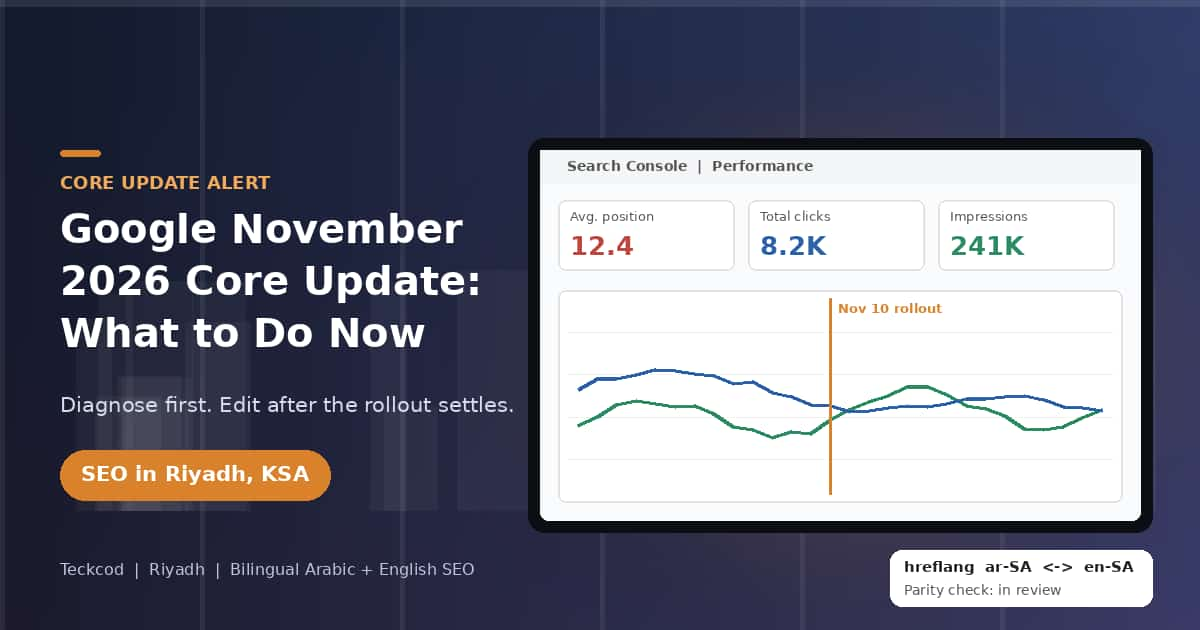
Quick answer: Google’s November 2026 core update launched globally on November 10, 2026, across all languages, and reassesses content helpfulness rather than issuing penalties. Wait until the roughly two-week rollout ends before making major edits, then audit methodically. An SEO expert in Riyadh KSA can protect bilingual Arabic and English rankings throughout.
Table of Contents
Google began rolling out its November 2026 core update on November 10, and Saudi sites are already seeing ranking movement. If you manage a Riyadh, Jeddah, or Dammam website, the worst response is panic editing. A seasoned SEO expert in Riyadh KSA will tell you the same: measure first, then act.
What Did the November 2026 Core Update Change?
The November 2026 core update is Google’s third broad core update of 2026, released on November 10 and applying to every language, including Arabic and English. Google calls it a regular update designed to surface relevant, satisfying content, and it also touches Discover and other search features.
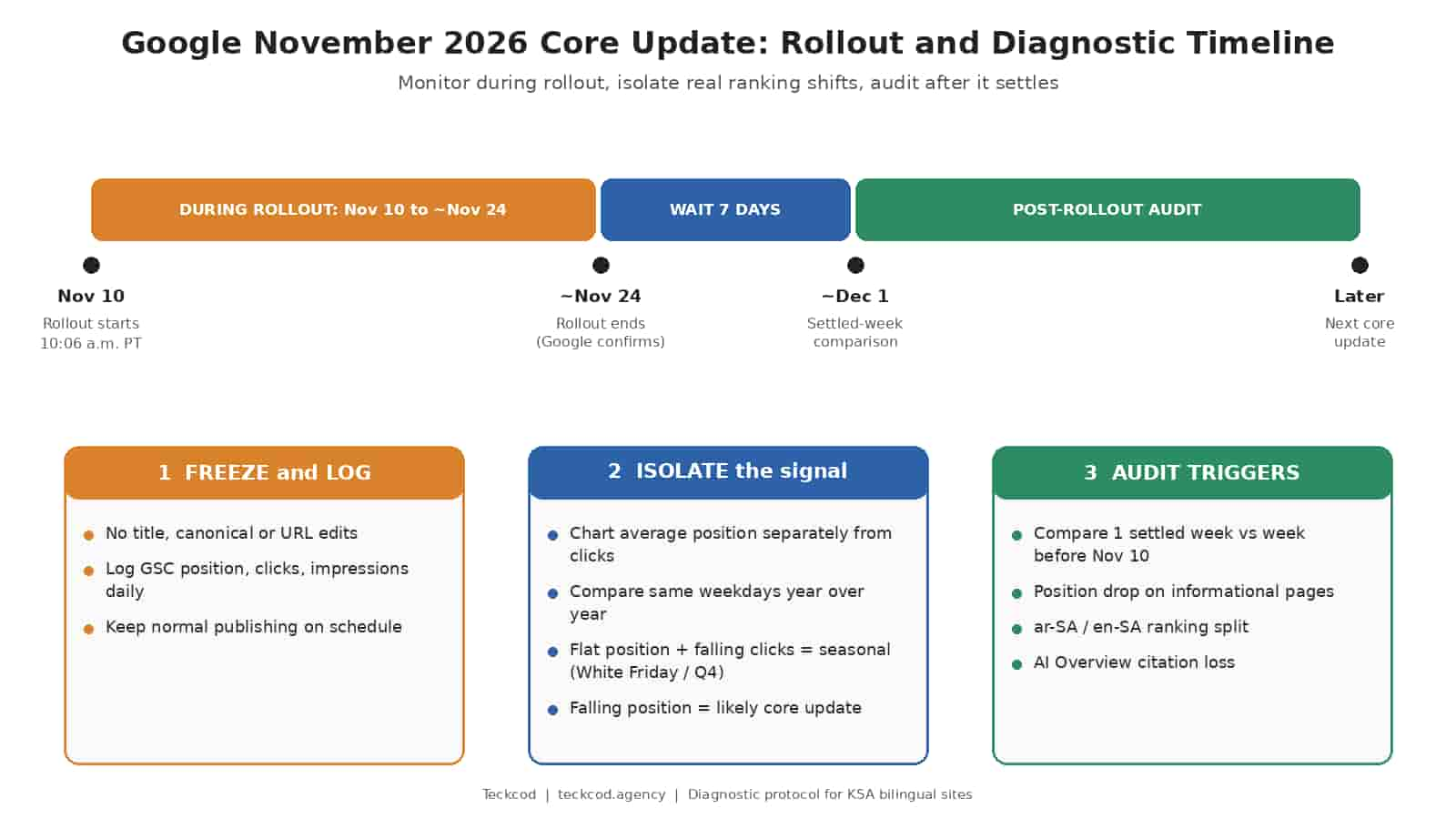
It follows the March 27 and May 21 core updates, plus the September spam update that finished around October 8. The rollout began at 10:06 a.m. Pacific on the Google Search Status Dashboard and may run up to two weeks, with most observers expecting completion near November 24.
Is This Update a Penalty or a Reassessment?
It is a reassessment, not a manual penalty. Core updates recalibrate how Google’s systems judge helpfulness, E-E-A-T, and search intent satisfaction across the whole index, so a ranking drop signals that competitors now satisfy users better rather than that your site broke a rule.
Google has not published AI Overview guidance specific to this update. Treat citation shifts as a secondary signal, and prioritise what Google does document: people-first content, clear sourcing, and satisfied searchers. Every SEO expert in Riyadh KSA should anchor advice to Google’s helpful content guidance.
How Should You Monitor Rankings During Rollout?
Monitor, do not edit. Track Google Search Console average position and click-through rate separately every few days, log every observation against the dashboard timeline, and freeze structural changes until the rollout closes, because mid-rollout rankings swing in waves and often reverse before settling.
- Do not rewrite titles, canonicals, or URL structures mid-rollout.
- Do log daily GSC position, clicks, and impressions per language folder.
- Do keep publishing normal, high-quality content on schedule.
- Do not buy links or bulk-generate AI content as a reaction.
How Do You Separate White Friday Noise?
Compare the same weekdays year over year and filter GSC queries into commercial and informational groups. White Friday and Q4 demand lift clicks on shopping queries regardless of any algorithm change, so a position drop on informational pages is the genuine core update signal, while click swings alone are usually seasonal.
What Should a Post-Rollout Audit Cover?
A post-rollout audit should cover content helpfulness, bilingual parity, technical health, and AI visibility, in that order. Wait at least a full week after Google marks the rollout complete, then compare that week against the week before the rollout started, exactly as Google’s core updates documentation advises.
What Is the 4-Phase Diagnostic Protocol?
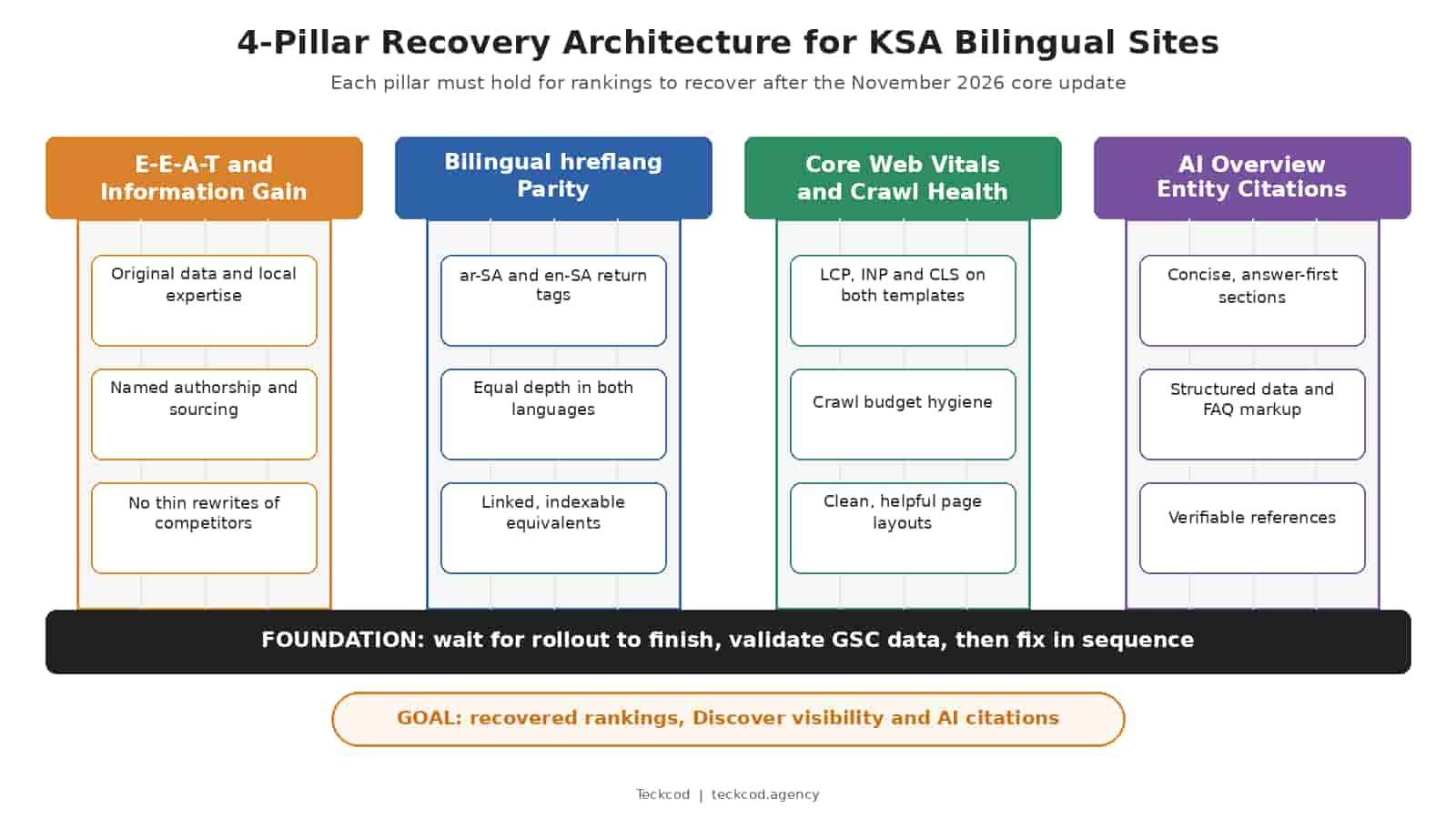
Teckcod’s 4-Phase Post-Rollout Diagnostic Protocol sequences recovery work for KSA bilingual sites so edits never collide with volatility. Phase one validates the data, phase two audits content and E-E-A-T, phase three fixes bilingual and technical faults, and phase four measures AI Overview citations and iterates.
- Validate (days 1-7 after rollout): isolate position drops from seasonal click noise in GSC.
- Audit content: run a helpful content E-E-A-T audit on pages that lost position, checking information gain, authorship, and sourcing.
- Repair: fix hreflang, crawl budget waste, and Core Web Vitals faults across Arabic and English templates.
- Measure: track AI Overview citations and Discover visibility, then iterate before the next core update.
Benchmark before you edit. Export your Google Search Console position shifts and check bilingual indexation for Arabic and English URLs. Then ask an SEO expert in Riyadh KSA to validate the baseline before anything changes.
Why Does Bilingual hreflang Parity Matter?
Bilingual parity matters because Google ranks ar-SA and en-SA URLs separately, and each must satisfy intent on its own. When the Arabic page is thinner, slower, or poorly linked to its English equivalent, it loses position even if the English page stays strong, so audit both versions together.
Bilingual Arabic English SEO Saudi Arabia projects start with parity: confirm every ar-SA page carries a matching en-SA return tag, comparable depth, and equal Core Web Vitals scores. Arabic templates can load heavier fonts and scripts, so LCP, INP, and CLS fixes belong with Core Web Vitals and technical web development specialists.
For content, ask whether each lost page adds information gain: original data, local expertise, and clear authorship. A good SEO expert in Riyadh KSA rejects thin rewrites of competitors’ pages. Cluttered layouts bury answers, so user-centric UI/UX design directly supports helpfulness.
| Observed GSC Symptom | Likely Root Cause | During Rollout | Post-Rollout |
|---|---|---|---|
| Position drop on informational pages | Weaker information gain or E-E-A-T versus competitors | Log and wait | Run helpful content audit; add original expertise |
| ar-SA and en-SA ranking split | Language parity, hreflang, or speed gaps | Document affected URLs | Align content depth, tags, and Core Web Vitals |
| AI Overview citation loss | Unclear entities, weak sourcing, or lost position | Monitor weekly | Add structured answers and verifiable references |
| Seasonal Q4 click fluctuation | White Friday demand, not algorithm | Compare year over year | No action unless position also falls |
Which SEO expert in Riyadh KSA Should You Hire?
Choose an SEO expert in Riyadh KSA who audits Google Search Console data forensically, engineers native Arabic and English content, and understands AI visibility. Avoid agencies that promise instant recovery mid-rollout, because no credible partner can guarantee outcomes while Google’s systems are still recalibrating.
Teckcod positions itself as a Riyadh digital growth agency with 8+ years of experience and an Al Khozama office, working as an SEO expert in Riyadh KSA: forensic audits, bilingual remediation, GEO, and a risk-free 1-Week Free Trial. The table below compares your realistic options.
| Provider | KSA Presence and Diagnostics | Bilingual and AI Visibility | Engagement Risk |
|---|---|---|---|
| Teckcod | Riyadh office; forensic GSC and core update diagnostics | Native Arabic and English engineering; GEO and AEO for AI Overviews | Risk-free 1-Week Free Trial |
| Traditional retainer-heavy agencies | Regional presence varies; generic audit templates | Mostly translated pages; limited AI focus | Long contracts before proof |
| AI-content and link-farm vendors | Offshore, minimal diagnostics | Bulk machine content; weak E-E-A-T signals | High exposure to future updates |
| Generalist freelancers | Individual availability; shallow technical tooling | Rarely cover hreflang or GEO | Single point of failure |
Ask any SEO expert in Riyadh KSA how they separate seasonal noise from algorithmic loss, audit ar-SA and en-SA parity, and handle delayed results. Clear, evidence-based answers signal a partner worth trusting.
What Is the Recovery Action Checklist?
The recovery checklist has six steps: wait for rollout completion, validate GSC data, audit lost pages, repair bilingual and technical faults, strengthen AI-ready answers, and re-measure after the stabilization window. Following this order prevents reactive edits that muddy your data and slow genuine recovery.
- Wait until Google marks the rollout complete.
- Compare one settled week against the week before the rollout.
- Audit lost pages for information gain and authorship.
- Run a technical SEO audit Riyadh sites can act on: hreflang, crawl budget, and Core Web Vitals.
- Support AI Overview optimization KSA goals with concise answers and structured data.
- Re-measure after the stabilization window with your SEO expert in Riyadh KSA, then iterate.
Google November 2026 core update recovery is gradual, and Google notes the effect can take months or arrive only with the next core update. That is why disciplined sequencing beats speed.
Want a clear read on your own data? Book a forensic SEO audit or start Teckcod’s risk-free 1-Week Free Trial. Partner with an SEO expert in Riyadh KSA who treats this update as an engineering problem.
Google November 2026 Core Update FAQs
When Did the November 2026 Core Update Start?
Google began rolling out the November 2026 core update on November 10, 2026, at 10:06 a.m. Pacific time, according to the Google Search Status Dashboard. It applies globally and to all languages, including Arabic and English, and marks the third core update of 2026.
How Long Does the Core Update Rollout Take?
Google says the rollout may take up to two weeks, and recent 2026 core updates finished in roughly 12 days. This update is therefore likely to conclude around November 24, though Google will confirm completion on its Search Status Dashboard and ranking release history page.
Can You Recover Rankings Before the Next Update?
Sometimes, but broad recoveries usually arrive only with the next core update. Google notes effects can take months, so improve helpfulness, bilingual parity, and technical health now, expect smaller rebounds after the rollout settles, and ask an SEO expert in Riyadh KSA to prioritise fixes.