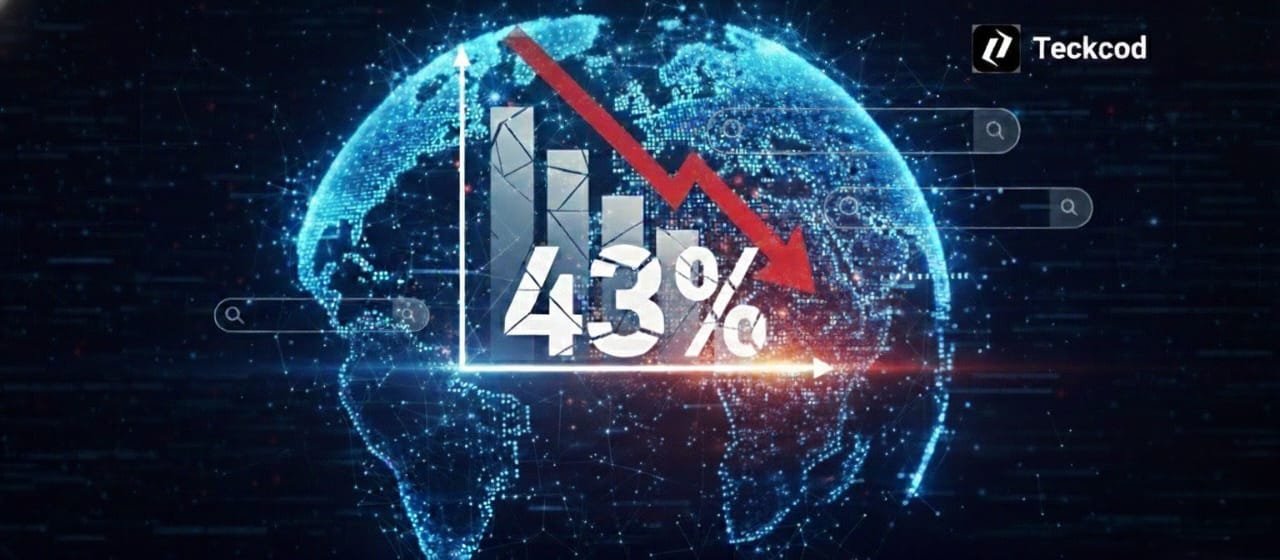
AI-driven search is reshaping how news content is discovered, consumed, and cited. Multiple industry reports warn that news publishers expect search traffic to drop by 43% by 2029, largely due to AI Overviews, zero-click searches, and generative answers replacing traditional clicks.
This guide is built to help publishers, editors, and SEO teams rank across multiple keywords, increase impressions and visibility, and adapt from classic SEO to AEO and GEO without missing any critical competitor keywords.
Why News Publishers Expect Search Traffic to Drop 43% by 2029
The news publishers’ search traffic drop is no longer theoretical. According to the Reuters Institute report, media executives forecast that search referrals will nearly halve within three years.
Data cited from Chartbeat shows organic Google search traffic declined 33% globally and 38% in the U.S. between November 2024 and November 2025.
Key drivers behind the search traffic decline:
- Google AI Overviews summarizing news directly in search results
- Growth of zero-click searches, where users get answers without visiting websites
- Search engines evolving into AI-driven answer engines
- Reduced click-through rates (CTR) despite stable or rising impressions
These trends signal a structural shift not a temporary fluctuation in how search works for publishers.
How AI Overviews and Zero-Click Searches Are Changing User Behavior
AI Overviews now appear in roughly 10% of U.S. search results, often at the very top. When they appear, studies show significantly higher zero-click behavior, meaning users consume content without clicking through to the source.
What this means for publishers:
- Content is increasingly treated as source material, not destinations
- SEO visibility no longer guarantees traffic
- Attribution and ROI models based purely on clicks are breaking
The impact is uneven. Lifestyle and utility content (weather, TV guides, horoscopes) faces the biggest squeeze because it is easy for AI systems to summarize. Hard news and original reporting have been more resilient so far.
From Traditional SEO to AEO and GEO: A Necessary Shift
The era of ranking blue links is giving way to Answer Engine Optimization (AEO) and Generative Engine Optimization (GEO).
Traditional SEO vs AI-Era Optimization
| Area | Traditional SEO | AI-Era SEO (AEO & GEO) |
| Primary Goal | Clicks | Citations & visibility |
| Focus | Keywords | Entities, authority, context |
| Success Metric | Rankings | Share of answer, mentions |
| Optimization Target | Pages | AI summaries & chat responses |
Publishers are increasingly dialing back classic Google SEO and experimenting with visibility inside AI platforms like ChatGPT, Gemini, and Perplexity.
The Rise of Zero-Click Searches and Declining Google Referrals
Search engines now prioritize on-platform retention, reducing outbound traffic. Even when publishers are cited, users often receive the full answer directly in search.
Key consequences:
- Lower CTR despite high impressions
- Shorter user journeys
- Reduced monetization from display ads, affiliates, and sponsored content
This is why many publishers say search still matters but clicks matter less.
Distribution Without Ownership: A Growing Publisher Risk
As AI systems summarize and repackage content, publishers lose control over:
- How stories are framed
- How credit is assigned
- How value is monetized
Attribution is getting murkier. If an AI agent answers a query using your reporting, does that count as a visit? Existing analytics tools struggle to measure agent-based consumption versus human traffic.
New Metrics Are Replacing Clicks in AI-Driven Search
A new KPI stack is emerging. Instead of focusing only on traffic, publishers must track:
- Citation frequency in AI answers
- Share of answer for priority topics
- Brand recall and recognition
- Visibility inside AI Overviews and chat results
A measurement arms race is coming, with new tools aiming to separate human visits from AI agent usage.
How Publishers Can Adapt to AI-Driven Search (Actionable Strategy)
1. Optimize for AI Visibility (AEO & GEO)
To increase the chances of being cited inside AI Overviews:
- Write clear summaries and definitions early in the article
- Use structured headings, bullet points, and concise paragraphs
- Publish original, fact-checked reporting
- Strengthen E-E-A-T signals (author bios, sources, transparency)
2. Shift from Keyword SEO to Entity Optimization
AI systems evaluate entities, relationships, and authority, not just keywords. This means:
- Building strong brand authority
- Connecting authors to topics consistently
- Reinforcing topical relevance across multiple articles
In the AI era, trusted brands are cited while weaker entities disappear.
3. Build Direct Audience Relationships
Reducing dependence on search requires investment in owned channels:
- Email newsletters
- Subscriptions
- Push notifications
- Mobile apps
Key engagement metrics now influencing AI visibility include:
- Dwell time
- Scroll depth
- Returning visitors
- Brand search demand
4. Diversify Traffic Sources Beyond Google
Smart publishers are expanding into:
- Social media optimization (LinkedIn, X, Instagram)
- Video SEO (YouTube, Shorts)
- Podcasts and audio platforms
- Selective content syndication
Licensing and Monetization as a Parallel Strategy
As referral risk grows, AI licensing is becoming a serious option. Publishers are exploring:
- Revenue-sharing agreements
- Negotiated citation prominence
- Content licensing for AI training and answers
Licensing will not replace audience traffic but it can reduce long-term dependency on search.
Future of SEO for News Publishers: Search Still Matters, but Differently
The future described by the Reuters Institute is clear: AI answers are becoming the interface.
Publishers that survive and grow will:
- Embrace AEO and GEO
- Measure success beyond clicks
- Focus on clarity, structure, and authority
- Balance distribution, attribution, and monetization
Bottom line: When AI-driven search systems deliver answers directly, SEO visibility, citation strategy, and brand authority are no longer optional. They are the foundation of modern search strategy for news publishers.
Key Takeaways
- News publishers expect search traffic to drop by more than 40% by 2029
- AI Overviews and zero-click searches are accelerating traffic loss
- Traditional SEO is evolving into AEO and GEO
- New metrics like share of answer and citation visibility matter more than clicks
- Publishers must adapt now to remain visible, credible, and sustainable in AI-led search
Conclusion
AI-driven search is reshaping how news content is discovered and valued. With publishers expecting a 43% drop in search traffic by 2029, traditional SEO and click-based growth alone are no longer enough.
AI Overviews, zero-click searches, and generative answers require a shift to AEO and GEO, stronger brand and entity authority, and success metrics like citations, share of answer, and brand recall, not just traffic.
Publishers that prioritize clarity, originality, structure, and trust will stay visible as clicks decline. Search will still matter, but being cited, trusted, and recognized within AI-driven interfaces will define true competitive advantage.