Table of Contents
- What Does Affordable Web Design in Saudi Arabia Really Mean?
- How Does Saudi Vision 2030 Change Website Requirements?
- How Do You Build Bilingual Arabic RTL and English LTR Websites?
- Which Payment Gateways Does a Saudi E-Commerce Website Need?
- How Do Core Web Vitals Perform on Saudi 5G Networks?
- Should Saudi Businesses Choose Custom Code or Page Builders?
- How Do You Evaluate a Web Design Agency in KSA?
- What Should Saudi Businesses Do Next?
- Affordable Web Design in Saudi Arabia FAQs
Most Saudi companies do not overspend on websites by choice. They overspend because the cheapest quote hides rebuild costs, slow mobile pages, and broken Arabic layouts. Within a year or two, the savings disappear.
This guide defines affordable web design Saudi Arabia buyers can verify, from total cost of ownership to bilingual engineering, local payments, and speed. It draws on the build patterns Teckcod applies for SMEs and startups across Riyadh, Jeddah, Dammam, Khobar, and Neom.
You will leave with two reusable tools: a 36-month TCO scorecard and a weighted agency evaluation matrix.
What Does Affordable Web Design in Saudi Arabia Really Mean?
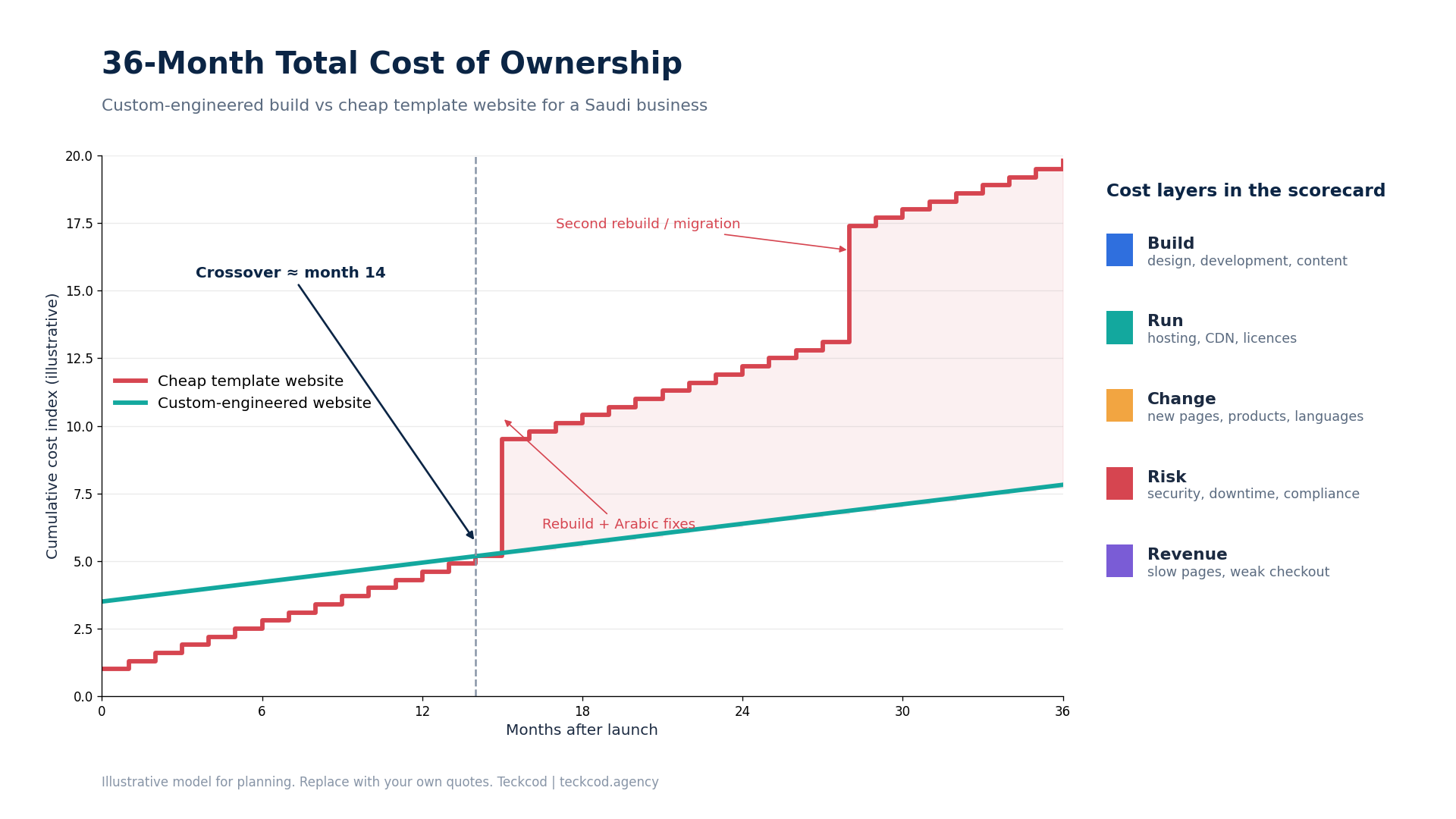
Affordable web design in Saudi Arabia means the lowest total cost of ownership over three years, not the lowest upfront invoice, and it depends on scalable code, strong conversion performance, and predictable maintenance. A cheap template that collapses under campaign traffic or needs a full Arabic rebuild costs far more than an engineered site that scales with demand.
When we scope affordable web design Saudi Arabia projects, we separate one-time build cost from recurring cost. That split shows why an engineered site often beats a discounted template within the first year. It also helps founders in Riyadh and Jeddah budget with fewer surprises.
How Do You Calculate Total Cost of Ownership for a Saudi Website?
Total cost of ownership equals build cost plus hosting, maintenance, security patching, redesign risk, and revenue lost to slow or broken pages across 36 months. Add every line item before comparing quotes, because the lowest quote rarely wins once recurring and hidden costs enter the calculation.
Use these five lines in your scorecard:
- Build cost: design, development, and Arabic plus English content setup.
- Run cost: hosting, CDN, licences, plugin subscriptions, and monitoring.
- Change cost: hours needed to add pages, products, or a new language.
- Risk cost: security incidents, downtime, and compliance updates such as consent handling.
- Revenue cost: conversion loss from slow pages or a weak mobile checkout.
Score each line from 1 to 5 for every quote. Template-heavy builds usually look cheap on the build line and expensive on the other four.
How Does Saudi Vision 2030 Change Website Requirements?
Saudi Vision 2030 pushes commerce, government services, and consumer habits online, so websites now act as core infrastructure rather than brochures. Businesses in Riyadh, Jeddah, and Neom need fast, bilingual, secure, and integration-ready platforms that connect to payments, logistics, CRM, and e-invoicing without rebuilds.
The national Saudi Vision 2030 programme is expanding the commercial ecosystem quickly. SMEs seeking affordable web development Riyadh teams can trust should expect their site to carry more load each year: more traffic, more integrations, more languages.
Compliance expectations rise with that growth. Online stores often need to connect to ZATCA e-invoicing workflows, and any site collecting personal data must respect the Personal Data Protection Law. Building these hooks into the architecture early costs less than retrofitting them later.
Treat the website as a modular system with four layers: front end, content, commerce, and integrations. Modularity lets a growing business add Arabic landing pages, new payment methods, or a mobile app API without replacing the whole stack.
How Do You Build Bilingual Arabic RTL and English LTR Websites?
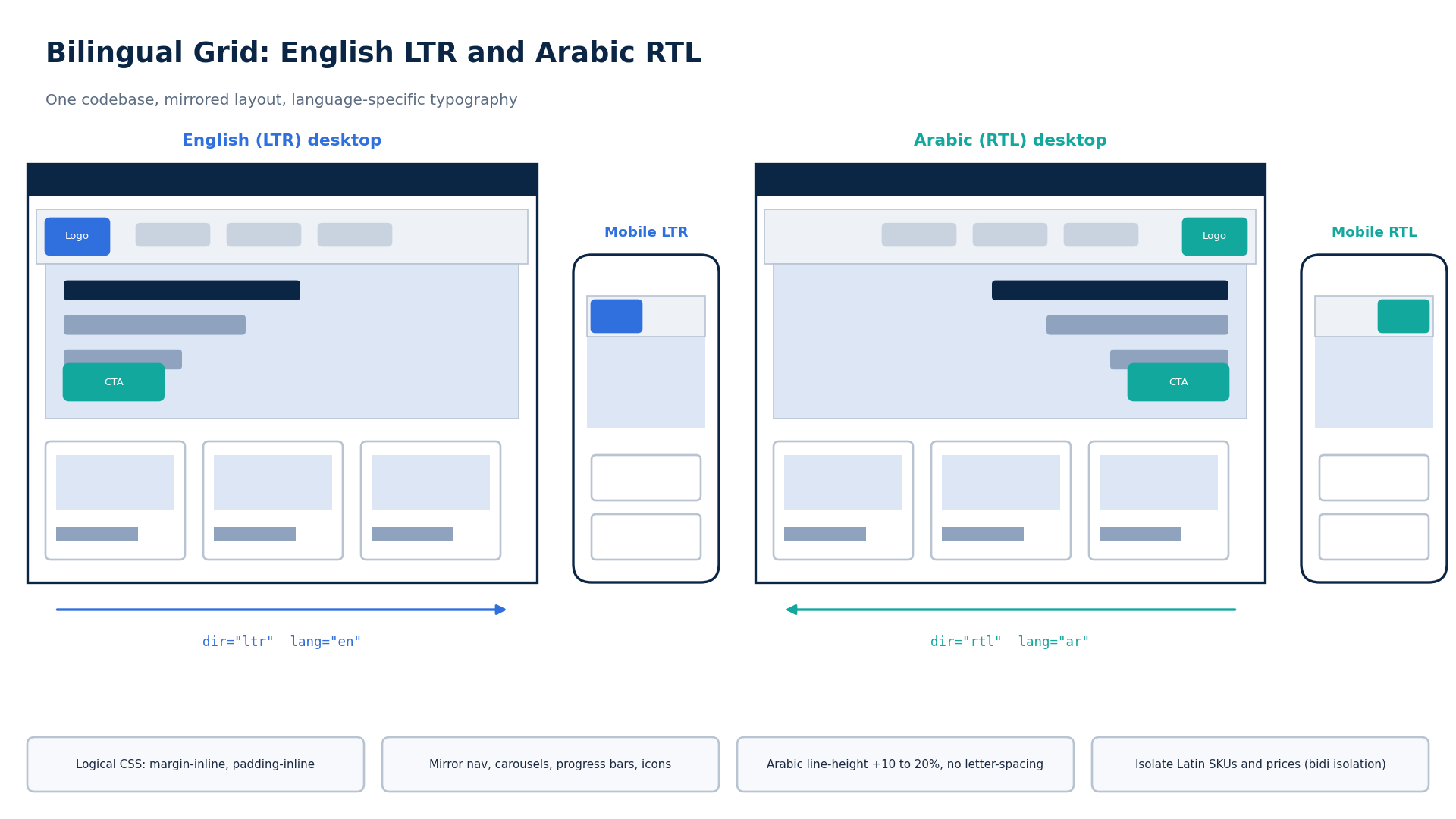
Build bilingual sites with one codebase that mirrors layout, navigation, icons, and spacing for right-to-left Arabic while preserving a distinct left-to-right English experience. Use logical CSS properties, language-specific typography, and native-written Arabic copy instead of machine-flipped layouts that feel foreign to Saudi users.
The W3C guidance on right-to-left text in HTML explains how the dir and lang attributes control direction and language. Set them at the document level, then isolate mixed-direction fragments. This is the foundation for accessible, search-friendly Arabic pages.
What Breaks When RTL Is Treated as an Afterthought?
Layout mirroring fails first, followed by icon direction, number formatting, form alignment, and mixed Arabic-English strings. Hard-coded left and right CSS values push buttons and menus to the wrong side, while bidirectional text scrambles phone numbers, prices, and product codes inside Arabic sentences.
Watch for these edge-case failures:
- Carousels and progress bars that still advance left to right.
- Arrows and chevrons that point the wrong way.
- Latin SKU codes that break Arabic line order without bidi isolation.
- Numeral and currency confusion between Arabic-Indic and Western digits at checkout.
- Fonts with poor letter joining or line heights that clip diacritics.
Which Typography and UX Rules Fit Saudi Users?
Choose Arabic web fonts designed for screens, such as IBM Plex Sans Arabic or Noto Kufi Arabic, and increase line height by roughly 10 to 20 percent over Latin text. Never apply letter-spacing to Arabic text, because it breaks letter joining and harms readability.
Cultural alignment goes beyond typography. Use imagery that fits local norms, offer Hijri-aware dates where relevant, and keep the language switcher persistent and obvious. Treat Arabic as the primary experience for local consumer audiences, not a translated afterthought.
Which Payment Gateways Does a Saudi E-Commerce Website Need?
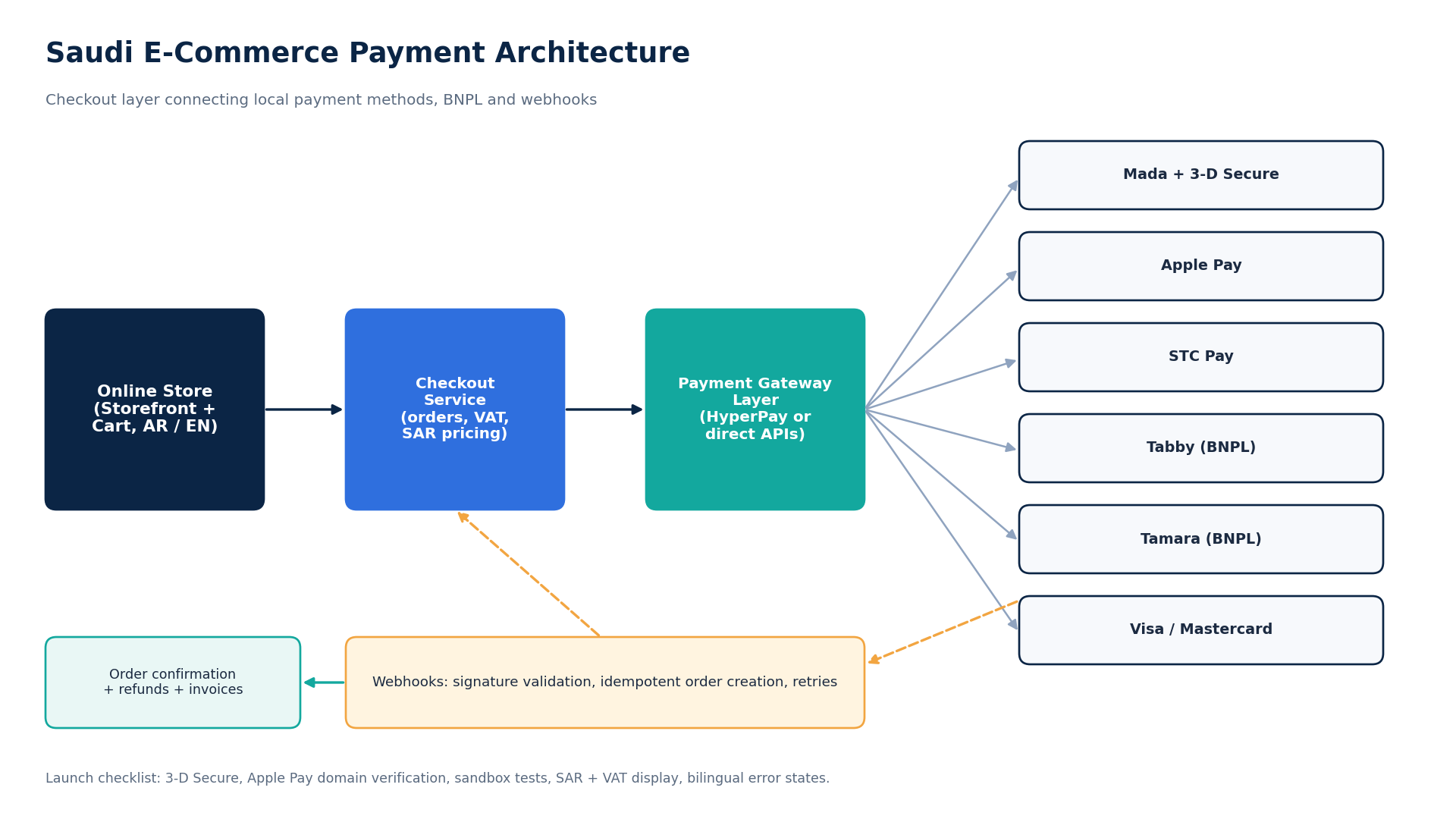
A Saudi e-commerce website needs Mada, Apple Pay, and major card schemes as the baseline, plus STC Pay and buy-now-pay-later options such as Tabby and Tamara. Aggregators such as HyperPay can bundle several of these methods behind one integration, which reduces engineering and maintenance effort.
Strong e-commerce website design Saudi Arabia shoppers trust starts with familiar payment options. Local methods signal credibility, and each missing method gives a returning customer a reason to abandon the cart.
How Should Mada, Apple Pay, and STC Pay Be Implemented?
Implement Mada through a certified gateway that supports 3-D Secure, and expose Apple Pay as a one-tap option on mobile Safari. Add STC Pay for wallet users, and order methods by local usage so the most trusted option appears first.
Test every method on real devices and issuer cards in staging. Verify webhook signature validation, idempotent order creation, and refund flows before launch.
Where Do Tabby and Tamara Fit in the Checkout Flow?
Place Tabby and Tamara on product pages and in the cart as instalment messaging, then offer them as payment options at checkout. Early visibility helps higher-ticket items, but eligibility limits and fees must stay clear to avoid abandoned carts.
Use this KSA checkout launch checklist:
- Mada and card payments verified with 3-D Secure.
- Apple Pay domain verification completed.
- STC Pay, Tabby, and Tamara sandbox tests passed.
- Webhook signature validation and retry logic in place.
- SAR pricing, VAT display, and Arabic invoices confirmed.
- Failed-payment and refund states written in both languages.
Want to pressure-test your checkout? Review how we scope bilingual commerce builds in our web design and development service guide.
How Do Core Web Vitals Perform on Saudi 5G Networks?
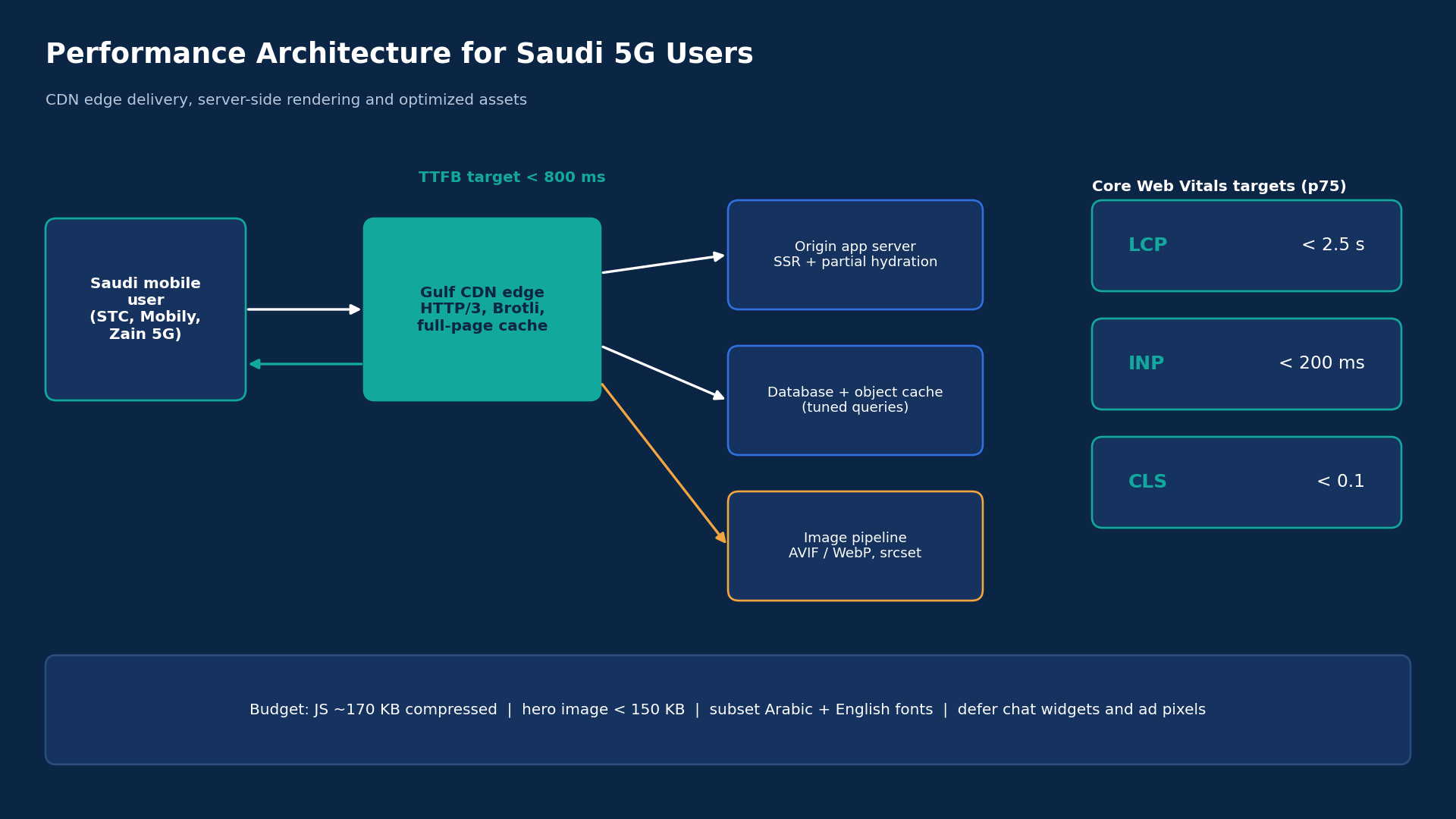
Core Web Vitals measure loading, interactivity, and visual stability, and Google uses them in its page experience signals. For users on STC, Mobily, and Zain 5G, target LCP under 2.5 seconds, INP under 200 milliseconds, and CLS under 0.1 at the 75th percentile.
Google’s Core Web Vitals documentation defines these thresholds. Fast 5G does not remove the need for discipline. Coverage varies by district, and heavy JavaScript still blocks the main thread on mid-range Android phones. Optimise for the median device, not the office iPhone.
Which Infrastructure Choices Keep Server Response Fast in KSA?
Host close to Saudi users on regional cloud infrastructure or a CDN with Gulf edge nodes, and cache rendered pages at the edge. Target a time to first byte below 800 milliseconds, supported by HTTP/3, Brotli compression, and tuned database queries.
What Is a Practical Performance Budget for a Mobile-First Saudi Site?
A common starting budget caps compressed JavaScript at roughly 170 KB on key templates and keeps hero images under 150 KB in AVIF or WebP. It limits third-party scripts to those with measurable revenue impact, and every sprint reviews the numbers against real-user data.
Apply these controls:
- Subset Arabic and English fonts and use
font-display: swap. - Server-render pages and hydrate only the interactive components.
- Serve responsive images with
srcsetand explicit width and height to prevent layout shift. - Defer chat widgets, analytics tags, and ad pixels until after first interaction.
Should Saudi Businesses Choose Custom Code or Page Builders?
Choose custom-engineered code for sites that must rank, scale, and integrate with local systems, and reserve page builders for short-lived campaign pages. Custom WordPress, headless CMS, and Next.js builds give you control over performance, security, and data, while locked-in proprietary platforms restrict all three.
Our custom WordPress development KSA work follows this principle: lean themes, audited plugins, and Arabic-first components instead of stacked page-builder layers.
Custom Web Design vs. Cheap Template Builders in KSA
| Criteria | Custom Web Design (Teckcod approach) | Cheap Template Builders |
|---|---|---|
| Speed | Optimised code and edge caching support strong Core Web Vitals | Bloated CSS and JavaScript, plugin stacking, slower LCP |
| SEO | Clean semantic HTML, hreflang control, structured data | Limited markup control, messy Arabic and English URLs |
| Security | Small attack surface, audited dependencies, role-based access | Outdated plugins, shared themes, weak access control |
| Scalability | Modular, API-ready, handles campaign spikes | Struggles under traffic, costly to extend |
| Arabic RTL | Native bilingual architecture | Mirrored afterthought with visual bugs |
| 3-year TCO | Higher build cost, lower run and change cost | Low build cost, high rebuild and patching cost |
When Should You Use WordPress, Headless CMS, or Next.js?
Use custom WordPress for content-led sites that marketing teams update daily, headless CMS with Next.js for high-traffic, multi-channel products, and React for app-like interfaces. Match the stack to your team and roadmap, because over-engineering raises cost just as surely as under-engineering.
Security controls that apply to every stack
- Role-Based Access Control for admins, editors, and vendors.
- API key rotation on a fixed schedule.
- Encryption at rest for customer and order data.
- Audit logging for logins, content changes, and payment events.
- Automated failure alerts for checkout, forms, and uptime.
How Do You Evaluate a Web Design Agency in KSA?
Score each web design agency in KSA on a weighted matrix covering bilingual engineering, performance evidence, payment integration experience, security practice, and post-launch support. Weighted scoring replaces gut feel with comparable numbers and exposes vendors who price low by skipping work that protects revenue.
Saudi Web Value Matrix
| Criterion | Weight | What to verify |
|---|---|---|
| Bilingual RTL and LTR engineering | 25% | Live Arabic pages, native copy, correct direction attributes |
| Performance evidence | 20% | Field Core Web Vitals data, not lab screenshots |
| Payments and integrations | 20% | Live references for Mada, Apple Pay, Tabby, Tamara, HyperPay |
| Security and compliance | 15% | Access control, patching routine, privacy-aware data handling |
| Scalability and code ownership | 10% | Repository access, documentation, no platform lock-in |
| Support and SLA | 10% | Response times, monitoring, maintenance retainers |
Ask each agency to score itself, then ask for proof. Teckcod builds against this same matrix as a specialized partner for custom, secure, and fully managed websites.
To be fair, page builders and marketplace themes can suit a pop-up campaign or a validation test. They fail when the site becomes a revenue channel. End-to-end managed builds cost more upfront and need a clear roadmap and maintenance discipline, but they carry lower long-run risk.
What Should Saudi Businesses Do Next?
Affordable web design Saudi Arabia buyers can trust starts with a three-year view of cost, a bilingual architecture, local payment coverage, and measurable speed. Run the TCO scorecard and the agency matrix before you sign anything. Then ask for field performance data, not promises.
If you want an engineered build instead of a template gamble, explore our affordable web design Saudi Arabia service for bilingual, payment-ready, performance-tested websites.
Ready to audit your current site? Schedule a technical consultation with Teckcod, a leading digital agency for Saudi web projects, and map your fastest route to a faster, bilingual, conversion-ready website.
Affordable Web Design in Saudi Arabia FAQs
How much does affordable web design in Saudi Arabia cost?
Costs vary by scope, and they depend on page count, languages, integrations, and custom features. Brochure sites cost the least, while bilingual e-commerce builds with Mada, Tabby, and Tamara require more engineering. Request a scoped quote and compare three-year total cost of ownership, not only the initial invoice.
Do I need an Arabic version of my website?
Yes, for most businesses selling to Saudi consumers. Arabic is the primary language for local shoppers, and native RTL layouts improve trust, usability, and search visibility for Arabic queries. B2B firms serving international buyers can launch English first, but should plan the Arabic version early.
Which platform is best for a Saudi e-commerce site?
WordPress with WooCommerce suits many SMEs, while headless builds with Next.js suit high-traffic stores. The best choice depends on catalogue size, team skills, and integrations with Mada, Apple Pay, Tabby, Tamara, and HyperPay. Prioritise code ownership and performance over the lowest build price.