
Quick answer: Yes, the Google September 2026 spam update is over. It began on 24 September 2026 and Google confirmed it was complete on 8 October 2026, after almost 14 days. It was global and applied to all languages. If your traffic dropped, check Search Console first, then follow the five-step triage below.
You opened Search Console this morning, saw a dip, and your stomach dropped. Totally normal. Every time Google says “spam update,” site owners assume the worst, and half of them start changing things that were never broken.
The good news is that the rollout has finished, so the numbers are finally readable. This guide explains what the Google September 2026 spam update was, how to tell whether it hit you, and what to do this week. No panic, no jargon.
Table of Contents
- Is the Google September 2026 Spam Update Over?
- What Did the Spam Update Target?
- How Do I Check If the Spam Update Hit My Site?
- Was It the Spam Update or Something Else?
- What Should I Do in the First Seven Days?
- How Long Does Spam Update Recovery Take?
- Which Mistakes Make a Drop Worse?
- What Should Saudi Arabia Websites Check?
- What If My Site Did Not Drop?
- FAQ
Is the Google September 2026 Spam Update Over?
Yes, the Google September 2026 spam update is complete. Google started the rollout on 24 September 2026 and marked it finished on 8 October 2026, which is about 13 days and 16 hours, far longer than the roughly two days the August update needed to finish.
Google said at launch that the rollout “may take up to two weeks,” and it used the full window. It described this as a normal spam update that applies globally and to all languages. You can confirm the dates yourself on the Google Search Status Dashboard.
Why does the finish line matter? Because ranking data during a rollout is unreliable. Positions shift, tools disagree, and some rank trackers showed swings that real searchers never saw. Now that Google has called it done, you can compare clean before and after periods.
What Did the September 2026 Spam Update Target?
The September 2026 spam update targeted sites that break Google’s search spam policies, but Google did not name specific tactics or publish a list of changes, so nobody outside Google knows the exact triggers. Spam updates improve Google’s automated spam-detection systems, known as SpamBrain, so the written policies are your best guide.
Here is the practical translation. These are the policy areas that most often cause trouble, based on Google’s own spam policies:
- Scaled content abuse: many low-value pages made mainly to rank, whether written by AI, by people, or by both.
- Link spam: bought links, link exchanges, and guest-post networks built for rankings.
- Expired domain abuse: buying an old domain just to borrow its authority.
- Site reputation abuse: third-party content hosted on a trusted site to exploit its rankings.
- Hacked or injected content: pages you never published, often casino or pharma spam.
Notice what is missing: ordinary, helpful content. The September 2026 spam update was not aimed at it. A normal business blog with real expertise is not the target. If you are unsure where you stand, our spam update recovery guide walks through the risk patterns in detail.
How Do I Check If the Spam Update Hit My Site?
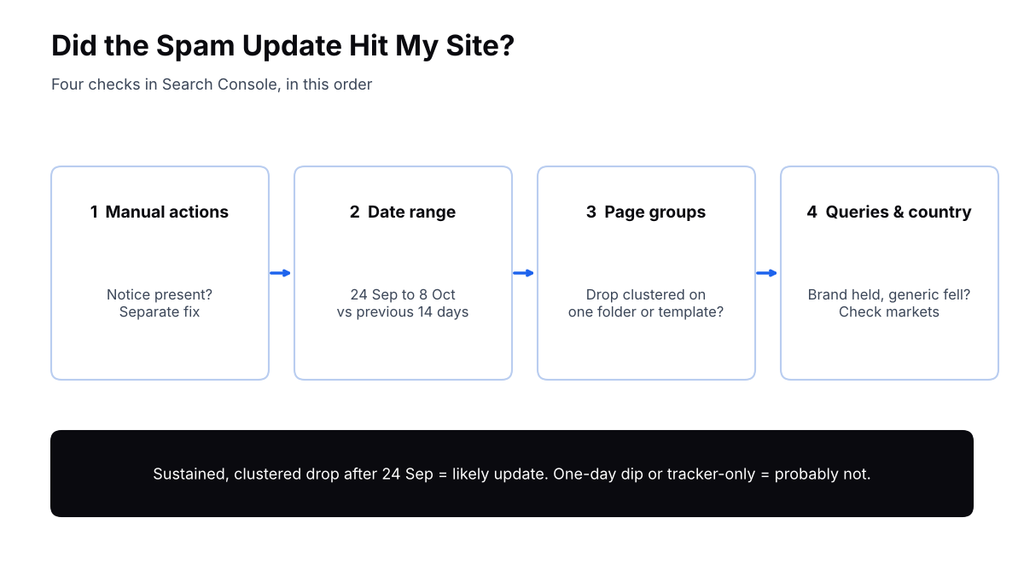
Open Search Console and compare the 14 days before and after 24 September, looking at clicks and impressions together. A real hit shows a drop that holds for several days across both metrics, while a single bad day, or a drop seen only in a third-party rank tracker, is usually not the update itself.
Follow this order. It takes about 20 minutes.
- Check Manual Actions. Go to Security and Manual Actions in Search Console. If a manual action exists, that is a separate problem with a separate fix.
- Set the right date range. Compare 24 September to 8 October against the previous 14 days. Better still, add the same period last year.
- Split by page type. Filter by folder or page group. Drops that cluster on one section (say, a programmatic location folder) are a stronger signal.
- Split by country and device. The new multi-country filter helps here if you serve several markets.
- Look at queries. Did branded queries hold while generic ones fell? That pattern tells a different story from a site-wide collapse.
Do not rely on rank trackers alone to judge the September 2026 spam update. SEOmonitor noted that many tools showed sudden ranking changes from 26 September that real users did not see, because Google returned incomplete results to automated checks.
Was It the Spam Update or Something Else?
Often it is something else, because a traffic drop during these two weeks can come from seasonality, tracking changes, a technical fault, or a different ranking change entirely. Only a sustained decline that clusters on certain pages and starts after 24 September points toward the September 2026 spam update.
Use this table to separate the likely causes.
| Possible Cause | What It Looks Like | What to Do |
|---|---|---|
| Spam update | Sustained drop in clicks and impressions, often on one page type, starting after 24 September | Run the triage below |
| Manual action | Notice in Search Console, sharp and sudden loss | Fix the issue, then file a reconsideration request |
| Seasonality or holidays | Drop matches last year’s pattern or a local holiday | Compare with the same dates last year |
| Tracking or tagging change | Analytics falls, Search Console stays flat | Audit your analytics setup |
| Technical issue | Crawl errors, indexing drops, slow pages | Check Page Indexing and Core Web Vitals |
| Core or other update | Broad quality-related movement, not tied to spam signals | Compare timing against Google’s update history |
Here is one data point. Diib analysed 32,569 sites and saw the median share of organic Google visits fall from 34% to 31% between 24 and 26 September, versus a week earlier. Sites losing half or more rose from 5% to 10%. Diib called it “an early read, not a verdict.”
What Should I Do in the First Seven Days After the Rollout?
Run a calm five-step triage instead of rewriting your site, because the goal this week is to confirm the cause, find the affected pages, and fix real policy problems. Do not make sweeping changes until you know exactly what changed, since panic edits are how small dips become big ones.
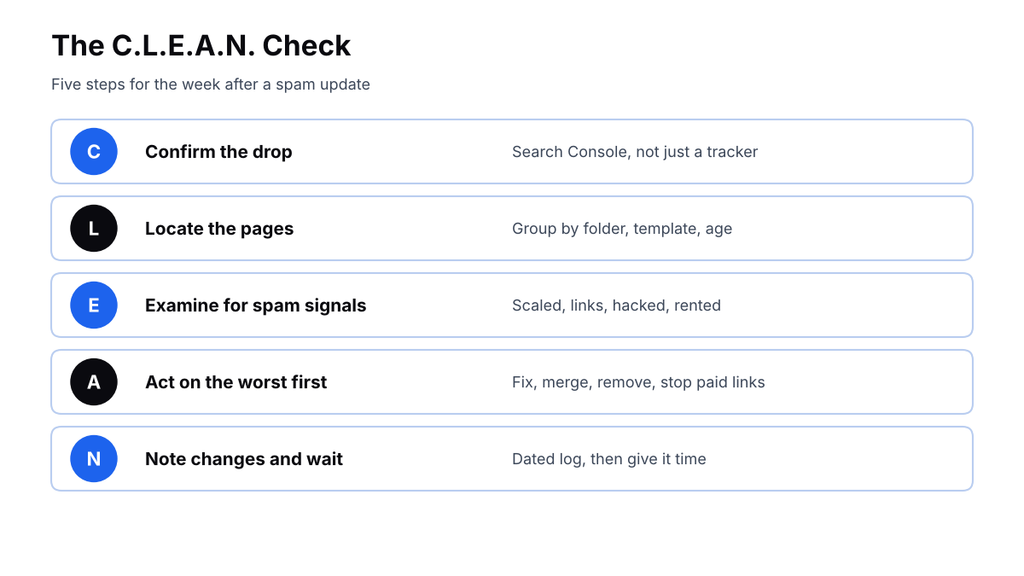
We call this the C.L.E.A.N. Check:
- C: Confirm the drop. Use Search Console, not just a tracker. Confirm it is sustained and not a one-day wobble.
- L: Locate the pages. Group URLs by template, folder, and age. Spam signals tend to cluster.
- E: Examine for policy problems. Look for scaled thin pages, bought links, hacked folders, and rented third-party sections.
- A: Act on the worst first. Remove or noindex hacked pages, improve or merge thin pages, and stop any paid link scheme.
- N: Note changes and wait. Keep a dated log of every change. Then give Google time to reassess.
That last step is the one people skip. A change log is gold later, because you can match movements to specific actions instead of guessing.
Key takeaway: Fix what genuinely breaks Google’s spam policies, document it, and resist the urge to change everything at once.
Want a second pair of eyes? If you are not sure whether the drop is spam-related, you can book a quick SEO audit to separate what is real from what is noise.
How Long Does Spam Update Recovery Take?
Spam update recovery usually takes months, not days, because Google’s guidance says its automated systems may recognise improvements only after a long period. There is no instant fix, spam updates can be refreshed later, and a reconsideration request only applies to manual actions, not to algorithmic drops like this one.
Timelines depend on the cause. This table sets realistic expectations:
| Problem found | Typical recovery path |
|---|---|
| Hacked or injected pages | Faster once cleaned and verified, but still not instant |
| Thin or scaled content | Slower: improve, merge, or remove, then wait for reassessment |
| Spam or bought links | The lost value does not return; earn new, genuine links instead |
| Rented third-party sections | Remove the section, then wait for signals to settle |
| No policy issue found | Likely not the update; look at other causes |
If you were hit by link spam, be honest with yourself. Removing the links you control helps hygiene, but the ranking value those links gave you is gone. Only real mentions and earned links can replace it.
Which Mistakes Make a Drop Worse?
The biggest mistakes after a spam update are panic edits, such as deleting good content, rewriting everything, or disavowing links wholesale, which can turn a small dip into a much bigger problem. Fix verified issues only, and keep every change small, deliberate, and documented in a dated log.
Avoid these five:
- Deleting your whole blog. Most helpful pages are not the problem.
- Mass-disavowing links. Without evidence of paid links, you may remove real value.
- Publishing more AI pages to “make up” traffic. That is exactly what scaled content abuse looks like.
- Judging by one tool. Cross-check with Search Console.
- Changing things during a rollout. You cannot learn from a moving target.
Here is the simple rule: if you change ten things in week one, you will not know in month three which one helped. Slow is smart here.
What Should Saudi Arabia Websites Check After the Spam Update?
Saudi websites should check the same spam-policy areas as everyone else, because the September 2026 spam update was global and applied to all languages, Arabic included. Google has not published Saudi-specific data, so use your own Search Console numbers filtered to Saudi Arabia and compare Arabic and English pages separately.
Some patterns common on Saudi and Gulf websites map directly to Google’s spam policies, so they are worth checking. These are policy-based risk areas, not confirmed triggers from Google:
| KSA-specific area | What to check | Why it matters |
|---|---|---|
| Machine-translated Arabic pages | Bulk Arabic versions of English pages with no native review | Looks like scaled content if the pages add no value |
| City-page templates | Near-identical Riyadh, Jeddah, and Dammam pages with only the city name swapped | Classic thin, scaled pattern |
| Bought directory and blog links | Paid placements on Arabic or Gulf blog networks | Link spam, and the lost value does not return |
| Rented or sub-folder content | Third-party “partner” sections on your domain | Possible site reputation abuse |
| National Day timing | Saudi National Day on 23 September fell the day before the rollout | Seasonal dips can look like update damage |
That last row is easy to miss. Saudi National Day on 23 September, plus the Sunday to Thursday work week, can distort day-by-day comparisons. Always compare full weeks, not single days, and use the same weekdays for before and after.
If you run a bilingual site, check that each Arabic page has its own purpose and human-reviewed text, and that your English and Arabic versions are linked with hreflang. A native editor is the cheapest fix for weak Arabic pages.
Want the full step-by-step plan? The spam update recovery guide for Saudi websites goes deeper on each step.
What If My Site Did Not Drop?
If your site held steady, that is a good sign but not a free pass, so use the quiet period to check your spam-policy exposure before the next update arrives. Spam updates come often, and the August one finished in about two days, so the next could land with little warning.
A simple health routine keeps you safe:
- Review third-party content and subfolders on your domain.
- Audit your link profile for paid or unnatural patterns.
- Check old or expired-domain redirects.
- Scan for hacked pages with a site search for odd keywords.
- Make sure every new page has a real reason to exist.
If you want a structured version of this, a periodic content and technical audit is the cheapest insurance you can buy.
Key takeaways:
- The September 2026 spam update ran from 24 September to 8 October 2026 and is now complete.
- It was global, applied to all languages, and Google gave no list of exact triggers.
- Check Search Console and manual actions before blaming the update.
- Use the C.L.E.A.N. Check: Confirm, Locate, Examine, Act, Note and wait.
- Recovery takes months. Fix real policy problems and avoid panic edits.
Whether the September 2026 spam update hit you or you just watched from the sidelines, the smartest move is the same: understand your data, fix what is genuinely risky, and keep publishing work that deserves to rank. If you would rather have experts review your site, talk to the Teckcod team.
FAQ
Is the Google September 2026 spam update finished?
Yes, the September 2026 spam update finished on 8 October 2026 after beginning on 24 September 2026, and it ran for about 13 days and 16 hours in total. Google confirmed completion on its Search Status Dashboard, so you can now compare before and after data with real confidence.
How do I know if the September 2026 spam update affected my website?
Compare your Search Console clicks and impressions for the 14 days before and after 24 September 2026, using the same date ranges for both metrics. A sustained drop that clusters on one page type, with no manual action and no tracking change, suggests the update affected you. A one-day dip or a rank-tracker-only drop usually does not.
Can I recover from the September 2026 spam update?
Yes, recovery from the September 2026 spam update is possible, but it usually takes months of steady work. Fix genuine spam-policy problems, such as thin scaled pages, hacked content, or paid links, and keep a dated change log of every edit. Google says its systems may recognise improvements over time, and reconsideration requests only apply to manual actions.