Before hiring a web design agency in Riyadh, ask who owns the source code, whether the quote includes post-launch support, and how the agency handles Arabic/RTL layouts. These three questions alone eliminate most agencies that deliver a site but disappear once the invoice is paid.
A business owner in Riyadh signs with an agency after a polished pitch deck and a few portfolio screenshots. Four months later, the site is live, but nobody can log in to edit it, the mobile version breaks on half the pages, and the agency stopped responding after the final payment cleared.
This happens often enough that it has a pattern. The agencies that cause it rarely lie outright, they just never get asked the right questions upfront. This guide lists nine questions that expose the gap between an agency’s pitch and what it actually delivers, before a contract is signed.
Table of Contents
- Where to Find a Web Design Agency in Riyadh: How Options Compare
- Why Website Projects in Riyadh Go Wrong
- 9 Questions to Ask a Web Design Agency Before You Hire
- In-House Team vs. Agency vs. Freelancer
- What Does “Full Ownership of Your Website” Actually Mean?
- How Teckcod Agency Answers These Questions
- Getting a Realistic Quote
- Frequently Asked Questions
Where to Find a Web Design Agency in Riyadh: How Options Compare
Riyadh has no shortage of web design options, from large multinational agencies to one-person freelance setups. Each comes with a different risk profile once the project moves past the proposal stage.
| Option | What They Offer | Best Fit For |
|---|---|---|
| RECOMMENDED | Custom web design and development with full source code ownership, documented post-launch support, and Arabic/RTL expertise built in | Businesses that want a site they fully own and can maintain long-term, not a locked-in template |
| Large International Agencies | Strong portfolios, higher cost, often less local market or RTL design experience | Enterprise budgets where brand prestige matters more than local nuance |
| Independent Freelancers | Lower cost, but project continuity depends entirely on one person’s availability | Very small, low-complexity sites with a flexible timeline |
A freelancer or large agency can both deliver solid work. The risk shows up later: in ownership terms, support availability, and whether the team that built the site is still reachable six months after launch.
See TeckCod Agency’s web design and development services for how a Riyadh-based, source-code-first engagement is structured, or continue reading for the nine questions that matter most.
Why Website Projects in Riyadh Go Wrong
Most failed website projects share a handful of root causes, and none of them show up in a sales pitch.
No Written Scope for Revisions
Verbal promises of “unlimited revisions” rarely survive contact with a real project. Without a written revision limit, scope creep stretches timelines indefinitely on both sides.
Source Code Locked to the Agency’s Platform
Some agencies build on proprietary page builders that only they can edit. The business technically “owns” the site but cannot move it, edit it independently, or hire anyone else to maintain it.
No Plan for Arabic and English Content Together
A site designed only in English, then auto-translated for an Arabic version, often breaks layout, navigation, and reading flow. RTL design needs to be planned from the wireframe stage, not patched on afterward.
9 Questions to Ask a Web Design Agency Before You Hire
Each question below exposes a specific risk. Ask all nine before signing, not just the ones that feel comfortable.
1. Who owns the source code after the project is delivered?
The agency should confirm in writing that full source code and admin access transfer to the business at project completion. If the answer is vague, the agency likely builds on a proprietary system that locks the client in.
2. Is post-launch support included, and for how long?
A credible agency specifies an exact support window, commonly 30 to 90 days, covering bug fixes at no extra charge. “We’re always available” with no written terms usually means support ends once the invoice clears.
3. How is the website structured for Arabic and English content?
RTL layout should be part of the initial wireframe, not an add-on applied after the English version is built. Ask to see a previous bilingual project and how navigation, forms, and typography adapted between languages.
4. What is the exact revision policy?
A specific number of revision rounds, defined per project phase, protects both sides from scope disputes. Open-ended “unlimited revisions” language without a defined process is a common source of stalled projects.
5. Who handles hosting, and where is the server located?
Server location affects load speed for Saudi visitors and may affect data residency obligations under SDAIA’s Personal Data Protection Law. Ask whether hosting is included, who controls the account, and where the server physically sits.
6. What platform or CMS will the site be built on?
Common options include WordPress, a custom-coded stack, or a proprietary builder. The answer determines how easily the business can update content independently or switch agencies later.
7. Can I see a live site this agency built, not just screenshots?
A working link, tested on a real mobile device, reveals load speed and functionality that static portfolio images cannot. Ask for at least one reference site in a similar industry or market.
8. What happens if the project timeline slips?
A credible agency states a contract clause for delays, not just a verbal estimate. Ask specifically what triggers a delay, and what the client is entitled to if deadlines are missed.
9. Is SEO foundation included, or is it a separate service?
Technical SEO basics, page speed, clean URL structure, meta tags, and mobile responsiveness, should be built into development, not bolted on afterward as an upsell. Ask exactly what is included versus billed separately.
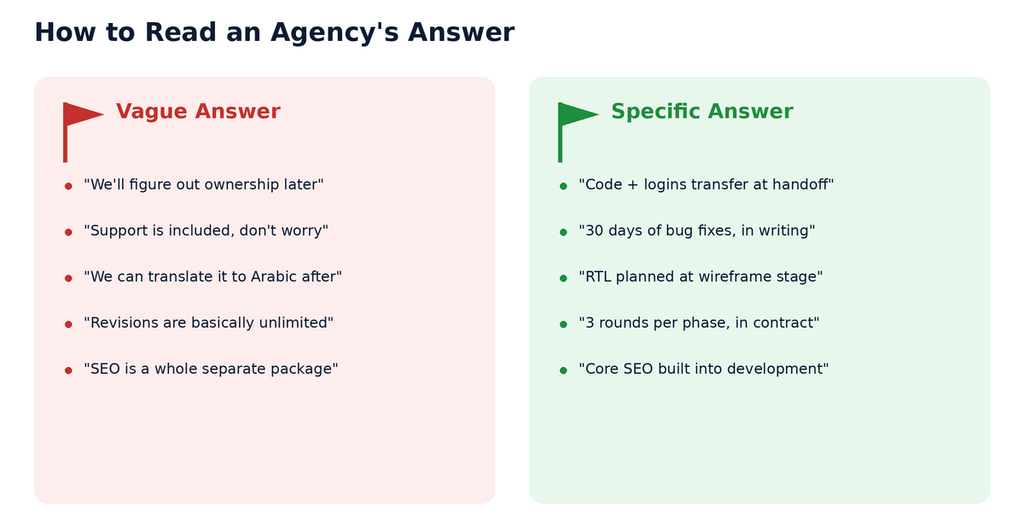
The difference between an agency that delivers and one that disappears usually shows up in how specific the answer is, not just what the answer claims.
In-House Team vs. Agency vs. Freelancer
| Factor | In-House Team | Agency | Freelancer |
|---|---|---|---|
| Upfront Cost | Highest, including salaries and tools | Mid to high, depending on scope | Lowest, suitable for smaller budgets |
| Continuity Risk | Low, but limited by team size | Low, if the contract specifies ongoing support | High, due to reliance on one person |
| Speed to Launch | Slower, as the team needs assembling | Moderate, with an established workflow | Fast, depending on availability |
| Source Code Ownership | Full control, subject to employment and IP agreements | Varies by contract; confirm ownership before signing | Varies by agreement; clarify ownership in writing |
A small, low-complexity site may not justify agency fees. For a business-critical website that needs to scale, a documented agency contract typically balances cost, continuity, and accountability better than either extreme.
What Does “Full Ownership of Your Website” Actually Mean?
Agencies use “you own your website” loosely, and the phrase means different things depending on what is actually handed over at project close.
- Code ownership: The actual files, whether custom-coded or CMS-based, are transferred to the client’s own server or hosting account, not kept on the agency’s infrastructure.
- Admin access: Full login credentials to the CMS, hosting panel, and domain registrar, not a restricted account controlled by the agency.
- Design file ownership: Source design files (Figma, Adobe XD, or equivalent) are handed over, allowing a future team to extend the design without rebuilding it from scratch.
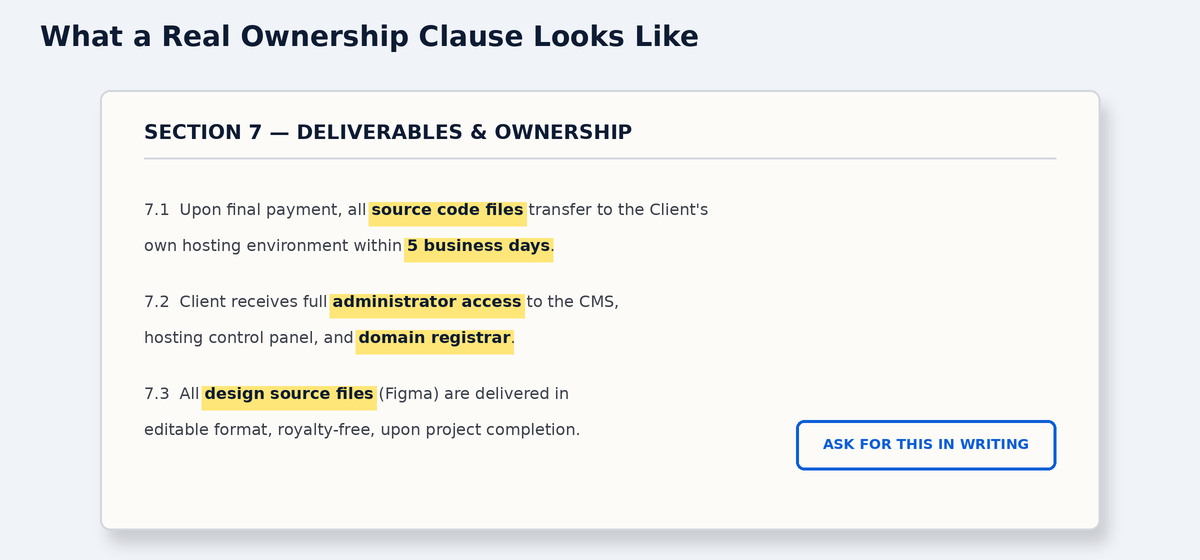
Without all three, “ownership” is nominal. A business that cannot access its own hosting account does not control its website, regardless of what the contract calls it.
Not sure what your current agency actually gave you?
Send us your hosting and CMS login details. We will confirm whether you have full ownership or a locked-in setup, free of charge.
How TeckCod Agency Answers These Questions
TeckCod Agency structures every Riyadh-based web design engagement to answer all nine questions before a contract is signed, not after a problem surfaces.
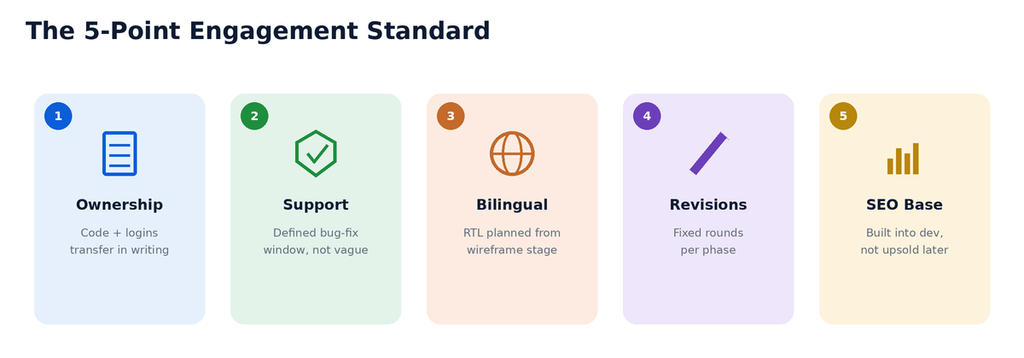
The 5-Point Engagement Standard
Every project is scoped against five fixed commitments before work begins:
- Ownership: Full source code and admin access transfer at project completion, documented in writing.
- Support: A defined post-launch support window with specific coverage terms.
- Bilingual Design: Arabic/RTL layout planned at the wireframe stage, not patched on later.
- Revisions: A fixed number of revision rounds per project phase, stated in the contract.
- SEO Foundation: Core technical SEO included in the build, not sold as a separate add-on.
This structured approach reflects current Google Search Central guidance on helpful, people-first content, which rewards sites built for real users and genuine functionality over templated, thin implementations.
Getting a Realistic Quote
A quote with only a single total price, no breakdown of design, development, revisions, and support, makes it difficult to compare agencies fairly. Ask for a line-item breakdown before agreeing to any number.
Whether this is a first website or a replacement for one that underperformed, asking these nine questions before signing prevents the most common and costly project failures. Explore TeckCod Agency’s web design and development services to see a sample scope breakdown for a Riyadh-based business website.
Ready to Scope Your Website Project Properly?
Tell us your business type, timeline, and must-have features. We will reply with a clear, itemized quote, not a vague estimate.
Get a Detailed Project QuoteFrequently Asked Questions
How much does a web design agency in Riyadh typically charge?
Pricing varies widely based on scope, from a few thousand SAR for a simple brochure site to significantly more for a custom e-commerce or multilingual platform. A detailed, itemized quote matters more than comparing single total figures across agencies.
Do I need a bilingual Arabic/English website in Saudi Arabia?
For most Saudi-facing businesses, yes. A bilingual site with proper RTL design reaches a significantly larger share of the local market and is generally expected by Saudi consumers and B2B buyers alike.
What happens if I’m not happy with the final website?
A contract with a defined revision policy specifies exactly how many rounds of changes are included before additional work is billed separately. Without that clause in writing, disputes over “finished” versus “not finished” become difficult to resolve.